
To compute the OPI values in the tree…Let q = the quotient of the lower OPI and r = its residue mod 3:
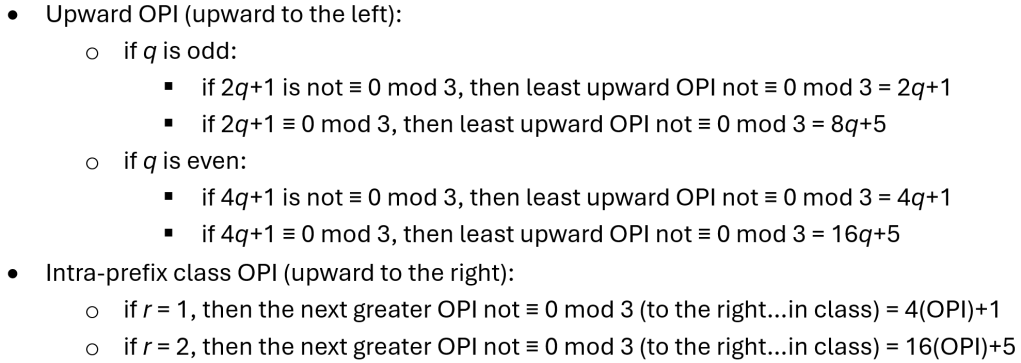
These rules will generate the identical OPI not ≡ 0 mod 3 found in the graph generated by the original Collatz function and will map onto the odd positive integer results of the original Collatz function precisely. The downward behavior of a terminal OPI ≡ 0 mod 3 will follow the same trajectory as any element not ≡ 0 mod 3 in its prefix class. The absence of all elements ≡ 0 mod 3 from consideration does not change the dependency structure of the OPIs that remain.
The above rules provide what we need to define a function between the set of integers and the set of odd positive integers not ≡ 0 mod 3. If we assign a 1 to each ‘step’ upward to the right (following the indicated conditionals) and a 0 to each ‘step’ upward to the left (again, following the indicated conditionals), then we will have assigned a unique, finite binary string to each vertex (the grey rectangles in the diagram) in the tree. That string, along with the indicated conditionals, then is a representation of the sequence of operations applied to any given OPI. Every such sequence of operations is non-commutative and unique as is its resulting value.
The structure is identical to that of the irrational elements >1 in the extension field encoded in the Stern-Brocot tree. In that tree between every two integer values to the right of 1 there is a subtree isomorphic to the whole left side (the subtree between 0 and 1). As encoded in the S-B tree every irrational element >1 in the extension field has a finite prefix and an infinite alternating tail. The tree is rooted at 1. There are no cycles. The structure is hyperbolic.
In the odds-only Collatz graph every downward path from an OPI will eventually reach 1 under iteration of Cp
Right click the image at top and open in a new tab for a better view of the details.
For definition of prefix class and further details…
 21st Century Paradox